Leeds South Bank and Leeds Dock: A Local's Guide
Free armour, a canal boat for the price of a coffee, an Egyptian temple in Holbeck and a brand new park: the side of the river most visitors never cross to.
By Only Leeds Editorial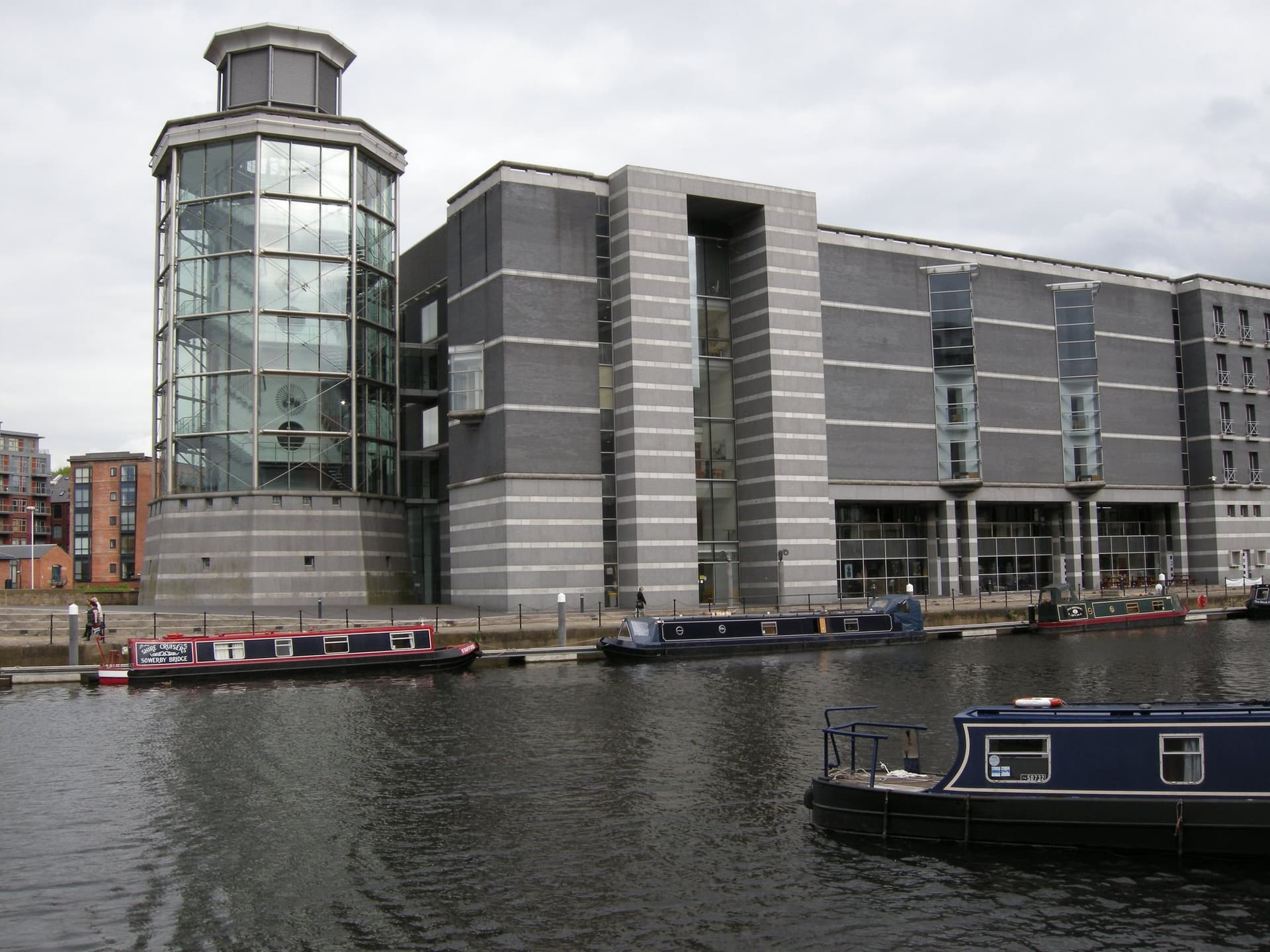
Leeds Dock is the old canal basin on the south side of the River Aire, about 20 minutes' walk from the station, and it is home to the free Royal Armouries Museum, a cluster of waterside bars and the most fun way to cross Leeds: a little water taxi from Granary Wharf. It sits inside the wider South Bank, the stretch of Holbeck and Hunslet that the city is busy rebuilding, where you will also find Temple Works and the brand new Aire Park. Most visitors never cross the river. They are missing a trick.
Getting there: take the boat
You can walk from the station to the Dock in 20 to 25 minutes, but the better option is the water taxi. It leaves from Granary Wharf, by the station's south entrance, and takes about 15 minutes to reach Leeds Dock, right outside the Armouries. The service has had breaks before and depends on river levels, so check the operator before you set off. If it is not running, the towpath walk is flat and pleasant enough, and you can tell people you meant to walk anyway.
Granary Wharf itself is worth a few minutes. The station above it was completed in 1869 on a run of brick arches over the River Aire, known locally as the Dark Arches, and it sits right next to the terminus of the Leeds and Liverpool Canal. The 2009 redevelopment brought apartments, bars and the hotel that is now the DoubleTree by Hilton, so it is a decent spot for a drink before or after the boat.
The Royal Armouries
This is the reason most people come. The Royal Armouries in Leeds is free, though you book a free ticket online, and opens 10am to 5pm, Tuesday to Sunday in term time and every day during school and bank holidays. It opened in March 1996, the first big build of the Dock's regeneration, and the Queen did the honours. Start with the Hall of Steel, a huge staircase whose walls are covered in a trophy display of 2,500 objects, then pick your galleries. The Tournament gallery has Henry VIII's foot combat armour, the Asian and African gallery has Indian elephant armour, and the Self Defence gallery has a pulse rifle from Aliens, which will keep any teenager quiet for at least ten minutes. There are daily combat demonstrations and shows included in your visit. Allow two to three hours and wear comfy shoes.
A bit of dock history
The basin was built in 1843 as Clarence Dock, a place to swap goods between boats on the Leeds and Liverpool Canal and the Aire and Calder Navigation. Mostly that meant coal from the pits around Rothwell and Wakefield, feeding the works of Hunslet. By the 1990s the warehouses were largely derelict. The Armouries kicked off the rebuild, a shopping and leisure scheme followed in 2008 without many shoppers, and in 2013 the developer Allied London renamed it Leeds Dock. Today it is mostly flats and offices, with around 1,800 people living on site and more than 2,000 working there, and it hosts events with partners including Light Night and the Armouries.
Eat and drink at the Dock
The Canary, on The Dockside, is the obvious stop: a cocktail bar and kitchen built out of yellow and black shipping containers, with waterside seats, craft beer and street food style plates. It is open 11am to 11pm every day and dogs are welcome. Order something cold, sit by the water and watch the water taxi go back and forth. It is not a big night out down here, more a long afternoon, and that is the charm.
Temple Works and Holbeck
Walk west along the river and into Holbeck to see the strangest building in Leeds. Temple Works, on Marshall Street, was built between 1836 and 1840 as a flax mill for John Marshall, and its office front is modelled on Egyptian temples, including the Temple of Horus at Edfu. The mill had a grass roof, and sheep were grazed on it to keep the air humid so the linen thread would not dry out. It is Grade I listed, the only Grade I building in Holbeck, and it closed as a mill in 1886. It has been empty a long time, but in February 2025 the government put £10 million towards bringing it into public ownership to test plans for a northern branch of the British Library. You cannot go in, but the outside alone is worth the detour, and it photographs beautifully in low winter light.
One note if you are following an older guide: the Cross Keys on Water Lane, long a Holbeck favourite, has been closed long term since early October 2026 and is looking for new tenants.
Aire Park and the new South Bank
The South Bank is the big regeneration area covering Holbeck and Hunslet, and its centrepiece so far is Aire Park, an 8 acre park that opened in July 2025 and is described as the largest new public park in the UK. It is a good place to sit with a coffee after the Armouries, and a sign of where this side of the river is heading. Expect cranes for a while yet.
A South Bank afternoon
Coffee near the station, the water taxi from Granary Wharf to Leeds Dock, three hours in the Armouries, then a drink at The Canary while the light goes. Walk back along the river via Aire Park, swing past Temple Works on Marshall Street, and finish at Granary Wharf for one more under the arches. It costs the price of a boat ride and a couple of drinks, and you will have seen more of Leeds than most people who live here.